Global Roadmap to End Deforestation Gets its First Stakeholder Test at World Bank Spring Meetings
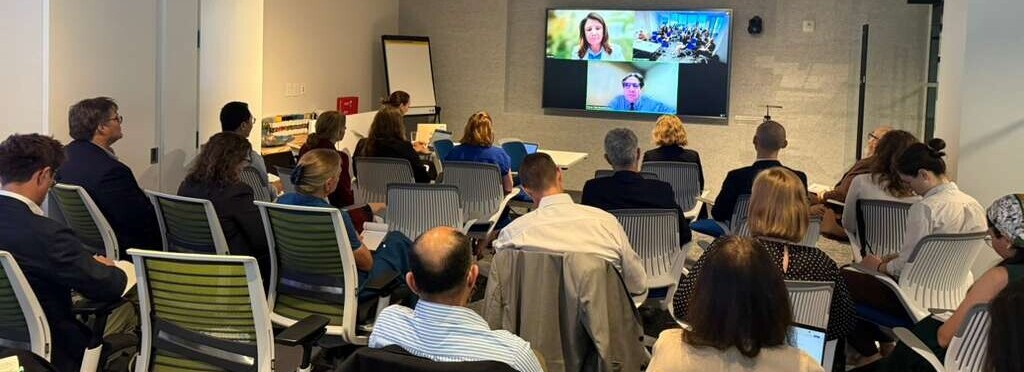
Ana Toni, CEO of the COP30 Presidency, and Marco Tulio Scarpelli Cabral, the roadmap lead, take part in a closed-door discussion. Photo: Irene Suárez.
The COP30 Presidency, National Audubon Society, and the Nature4Climate Coalition convened a high-level session at the World Bank Spring Meetings last week — the first opportunity for governments, financial institutions, and civil society to engage directly with Brazil’s COP30 Presidency since the close of the public consultation for the Roadmap for Halting Deforestation and Forest Degradation on 10 April.
Read more
Related articles for further reading
Ana Toni, CEO of the COP30 Presidency, and Marco Tulio Scarpelli Cabral, the roadmap lead, outlined the direction of travel and took questions from stakeholders from governments, multilateral institutions, development finance actors, central banks, research organisations, foundations, non-governmental organizations, and international bodies, including IUCN and Global Optimism.
What emerged from the discussion
On delivery: Participants emphasised that the roadmap should function as a practical delivery mechanism — not just a statement of intent. That means supporting coordinated action, clarifying which institutions are responsible for what, and maintaining momentum well beyond COP31. Participants also noted the unique opportunity to seize on the roadmap process to catalyze high-level momentum to end deforestation and forest degradation by 2030.
On finance: Realigning economic incentives was identified as the central lever — through fiscal reforms, repurposing subsidies harmful to forests, strengthening market signals, and scaling investment. Participants flagged that engagement with financial institutions, central banks, and multilateral development banks is critical and needs to go further.
On policy: There was broad convergence that forests must be repositioned within economic decision-making — recognized as a central priority for economic growth by finance ministries and development agendas, not siloed within climate and biodiversity policy alone.
On process: The roadmap will not be a negotiated text. Participants stressed it should act as a unifying framework — connecting and accelerating existing commitments and processes across climate, biodiversity, and land agendas rather than adding to an already crowded field of initiatives.
What comes next
Participants highlighted that the coming months represent a critical window to translate commitments into implementation. The roadmap will be tested and refined through a series of political and technical moments across 2026, with discussions planned for the UN Forum on Forests, UNFCCC intersessionals in Bonn, London Climate Action Week, and UN Climate Week NYC — ahead of delivery of the roadmap before COP31.
Key quotes:
Ana Toni, CEO, COP30 Presidency: “This is not a negotiated roadmap — it is not part of a consensus process. This is an offer from the COP30 Presidency to provide something practical, to look at solutions that can help us halt and reverse deforestation and forest degradation by 2030, so that we can accelerate action.”
“There is already a lot of work — international standards, national policies, and solutions that this community has developed over many years. So this roadmap is about building on that work and identifying what can be scaled and accelerated.”
Marco Tulio Scarpelli Cabral, Forest Roadmap Lead, COP30 Presidency: “It’s not going to be easy to halt and reverse deforestation and forest degradation by 2030. We believe this is a level of ambition comparable to the Paris Agreement itself — just as it is difficult to limit warming to 1.5 degrees, it will also be very difficult to deliver on forests. Difficult as it is, it is vital and we have to aim for it”
“There are already many studies and reports about forests and how to address the problem. But we need more than that — we need political mobilisation and commitment.”
Christine Dragisic, Audubon’s first Managing Director for Global Policy: “Under Brazil’s leadership, this roadmap is a unique opportunity to catalyze global momentum to end deforestation and forest degradation by 2030, and restore forests and other ecosystems. The National Audubon Society recognizes the critical role forests play for birds, communities, and economies. Reenergizing the will of government, corporate, and civil society leaders to conserve these critical ecosystems should be one of our highest priorities.”
Media enquiries
For more information or to arrange interviews with experts from our network — including representatives from environmental NGOs and international civil society organisations engaged on forests, climate finance, and the multilateral process — please contact Mariana Ceccon [mariana.ceccon@nature4climate.org]