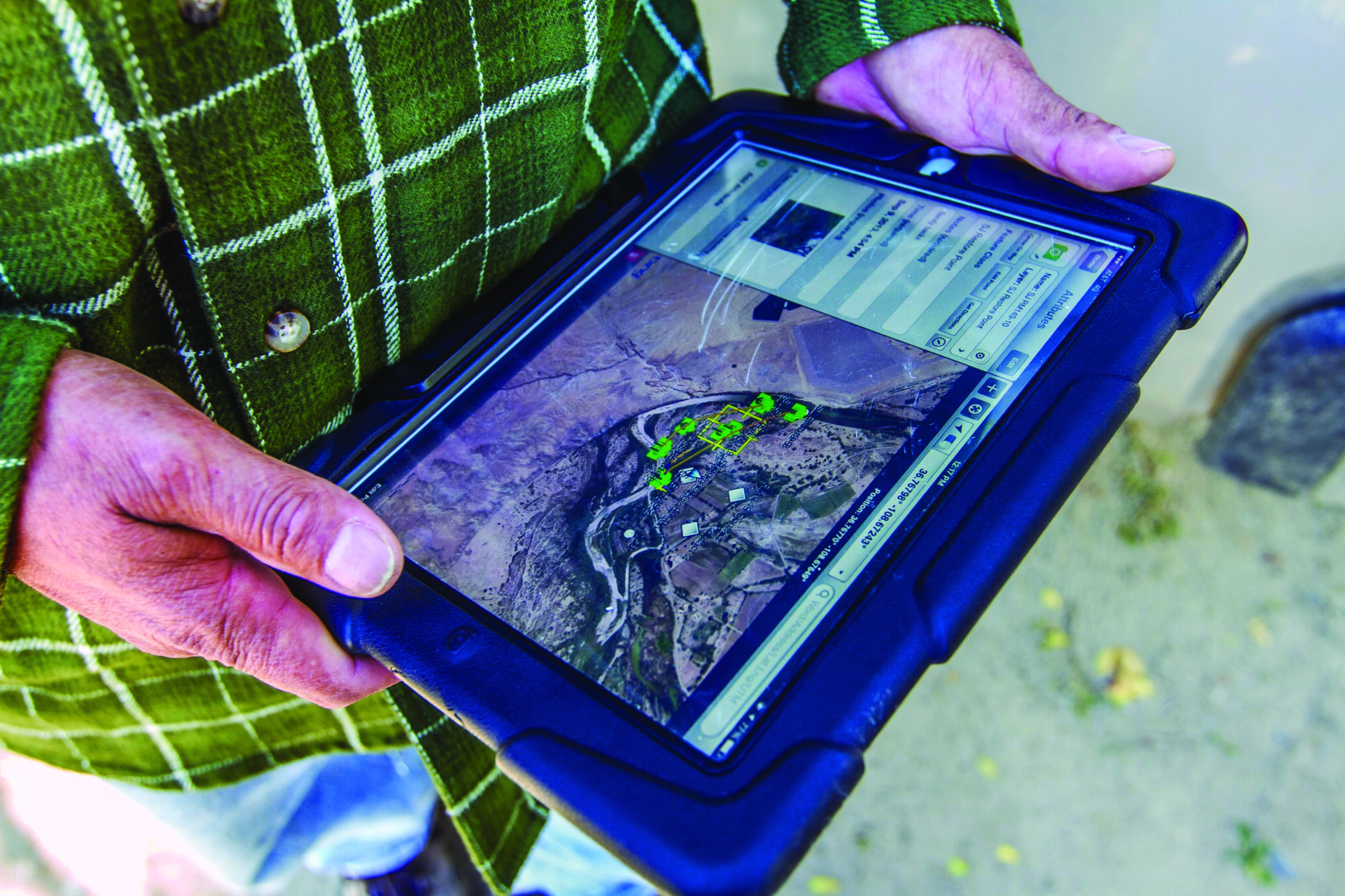
Gary Jordan, of Keller-Bliesner Engineering, uses a tablet to identify potential restoration sites along the San Juan River near Shiprock, New Mexico. Photo: TNC
* Since COP29, 26 new nature commitments have been announced, according to the latest update from the N4C Commitment Tracker. This number is five times higher than the announcements made between the Dubai and Baku conferences. In 2024, prior to the start of COP29, we identified only 5 new commitments.
* N4C is tracking 180 nature-related commitments made since 2019. Only half of tracked commitments that are 6-months or older reported their progress on implementation this year. This is a slight decrease from the 52% of commitments that reported progress in 2024.
* In a positive trend, nearly 54% of commitments announced since COP29 make direct reference to including Indigenous Peoples and Local Communities (IP&LC) in their planning, implementation, and benefit sharing strategies. Still, overall, only 24% of total commitments tracked in the past six years make these types of references to IP&LC inclusion.
* There is increased interest in working in Latin America, with roughly 35% of all new commitments basing their activities in the region. Amongst all commitments, Latin America accounts for just under 17% of commitments, with most (~57%) focused on global/multi-regional initiatives.
Read more
Related articles for further reading
Momentum Amid Uncertainty
The past year has seen major shifts in global climate action. The withdrawal of the United States from international climate diplomacy, coupled with economic strains and shifting political priorities, has slowed progress across many areas of climate policy. Yet, the latest results from Nature4Climate’s Nature-Based Solutions (NbS) Commitment Tracker suggest that the nature agenda is proving to be resilient.
This new update highlights a sharp increase in new joint action commitments and the emergence of new trends in implementation, inclusivity, and geographic focus — indicators that the global nature community is adapting and evolving in response to changing conditions.
“Given the geopolitical turbulence this year, we would expect to see some level of decline in reported progress against climate commitments. The fact there is only a slight decline in nature-related commitments reporting on their efforts and increase in overall new commitments suggests an encouraging resilience in this area which can be explained in a number of ways: the decentralized aspect of NbS implementation, the relatively lower implementation cost compared to, say, renewable energy installation, and the broad base of actors invested in NbS progress including at a corporate level. There is also evidence that nature-related action is less subject to the same political swings as climate action has been experiencing.”
— Lucy Almond, Chair, Nature4Climate
A 420% Increase in New Commitments
This update finds a 420% increase in the number of joint action commitments made since the last reporting period. While the previous update (released ahead of COP29) identified only five new commitments, this latest review adds 26 new entries to the tracker. This appears to be a sign that actors across sectors remain motivated to collaborate on nature outcomes despite broader global uncertainty.
Amongst the new initiatives are a few that are inspiring greater ambition ahead of COP30. The Brazil Restoration and Bioeconomy Finance Coalition launched during COP39 last year has achieved almost half of its goal to mobilize US$10 billion to restore forests and invest in Brazil’s bioeconomy by 2030. The Tropical Forest Forever Facility, a major initiative for Brazil’s Presidency of COP30, is poised to be a potentially game-changing initiative for financing forest conservation having drawn political support from a wide range of countries already. Lastly, the High Integrity Forest Investment Initiative has already secured significant financial and logistical support from partners like Bank of America, the Central Africa Forest Initiative, Good Energies and the UBS Optimus Foundation to keep healthy, intact forests protected.
Implementation Gap: 50% of Older Commitments Reporting Progress
A persistent challenge remains around transparency and accountability. Only 50% of commitments six months or older reported progress on implementation. A slight decline from 52% in the previous update. This underscores the need for improved reporting mechanisms and more consistent follow-through on pledges.
Several factors may help explain this shortfall. Some commitments were backed by U.S. government support or funding streams that have since been deprioritized. Meanwhile, reductions in international climate aid from other nations as the world wrestles with economic downturns may have also affected ongoing implementation and reporting.
Yet there are promising signs. Among new commitments that are at least six months old, 62% have already reported on progress suggesting that newer initiatives are embedding accountability more deeply in their design.
“Implementation will remain central to the COPs for the foreseeable future. By organizing our efforts around clear objectives and consistent engagement — day by day, year by year — we can increase efficiency and productivity. This architecture itself could become one of COP30’s strongest legacies.”
— Dan Ioschpe, High Level Climate Champion for COP30 and Chairman, Iochpe-Maxion
Increasing Inclusion of Indigenous Peoples and Local Communities
One of the most encouraging trends emerging from this update is the growing focus on IP&LC inclusion. Across all tracked commitments, only 24% explicitly reference IP&LCs in their planning or implementation strategies. Among new commitments, however, that figure rises to 54%.
This increase signals a welcome shift in how new initiatives are being designed. IP&LCs are increasingly recognized as central to the success and longevity of NbS. Embedding their perspectives, governance systems, and including them in benefit-sharing mechanisms from the start will be essential to building durable, high-integrity outcomes.
Regional Focus: Spotlight on Latin America
Another notable shift is geographic. Roughly 35% of new commitments focus on Latin America — double the region’s overall share (17%) across all tracked initiatives. While most commitments remain global or multi-regional in scope (57%), the growing emphasis on Latin America reflects both the region’s ecological importance and its rising leadership in NbS implementation.
With COP30 set to take place in Belém, Brazil, the uptick in Latin America-focused initiatives could signal the start of a new wave of regional partnerships and financing mechanisms centered on nature action.
Looking Ahead
The latest Commitment Tracker results point to a mixed but encouraging picture. New joint action commitments are surging, and many are being built with stronger mechanisms for accountability, inclusion, and regional focus. However, the broader implementation and reporting gap remains a significant challenge that must be addressed to maintain credibility and momentum.
Brazil’s COP30 presidency has called for fewer new announcements and greater emphasis on delivery. If current trends continue, the nature community may be well-positioned to meet that challenge as we translate ambition into tangible outcomes for people, climate, and biodiversity.
Nature4Climate will continue tracking and sharing progress to help ensure that commitments to nature are not just made, but kept.
How to use it?
Our evaluation is based on thorough desktop research, and we remain committed to maintaining its accuracy by incorporating any additional information as it becomes available. The regions in question are categorized according to the geographical areas where these commitments are being implemented.
To enhance clarity, we have implemented a color-coded methodology that provides a visual representation of the degree of progress communicated and achieved for each commitment: Red – No published evidence of action or progress; Yellow – Some evidence of action or progress; Light Green – Substantial evidence of action or progress; and Green – Complete or fully on track to meet the commitment.