The need for common language and synthesis in reversal risk compensation and mitigation approaches
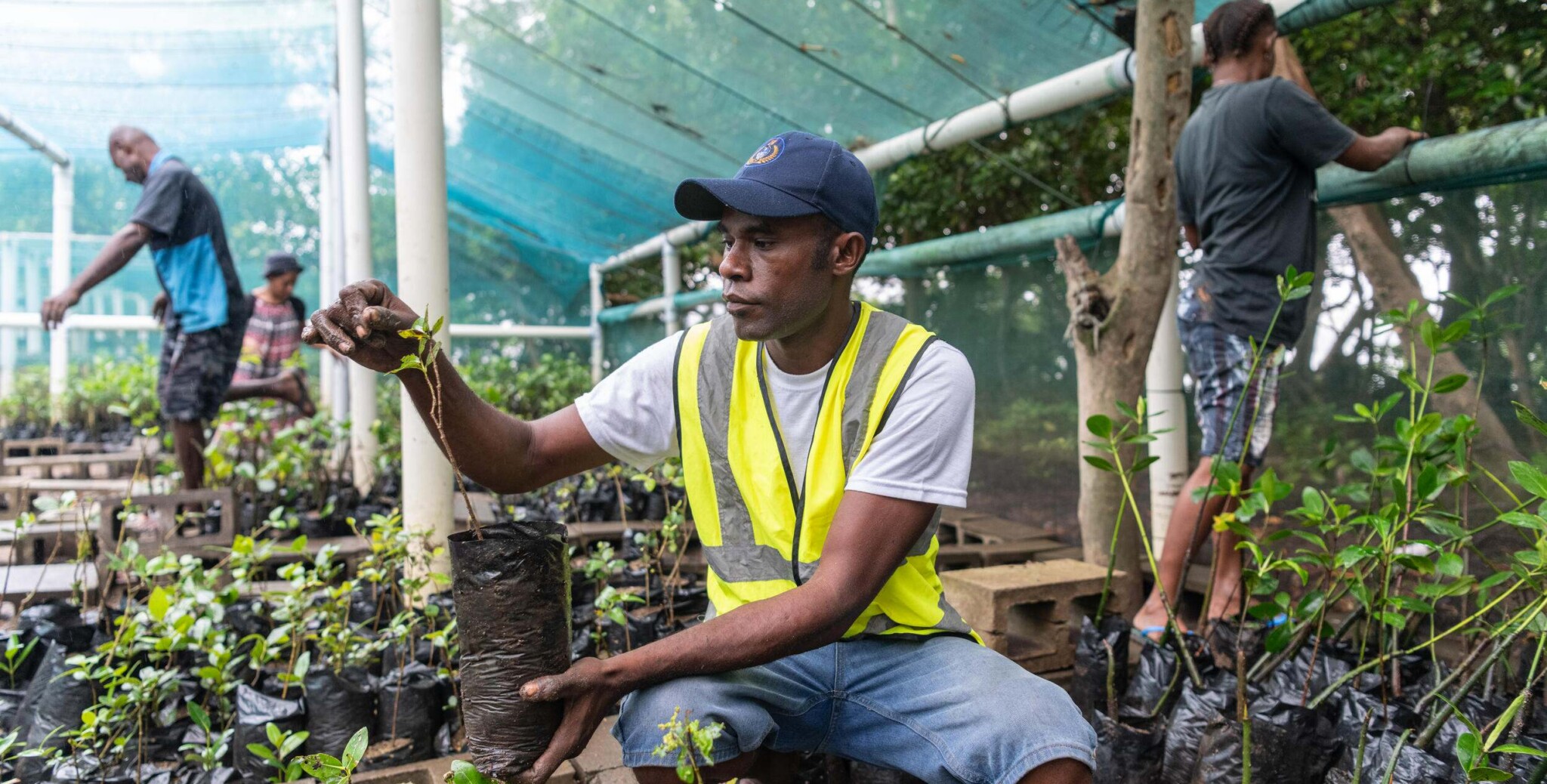
Community members work with mangrove saplings at Tahira Nursery in Bootless Bay, Papua New Guinea. Photo: Copyright ©Annette Ruzicka
This guest article was written by the Yale University Center for Natural Carbon Capture team: Sara Kuebbing, Savannah D. Gupton, Ingrid Thyr and Michelle Kirchner*
Forests, soils, and other ecosystems are proven mechanisms for removing and storing carbon from the atmosphere, sometimes for thousands of years. But disturbances like wildfires, droughts, and storms– that are growing in frequency and severity– can lead to reversal events that emit carbon back to the atmosphere and reduce the climate benefits of nature-based solutions. However, the existence of this “non-permanence risk” for ecosystem-based carbon storage does not mean that natural climate solutions are inviable for mitigating climate change. As one essential component of a broader portfolio of climate solutions, natural climate solutions remain critical to global climate change mitigation goals. Effective deployment of natural climate solutions will require policy innovation and governance frameworks that ensure carbon remains out of the atmosphere long enough to fulfill climate mitigation claims.
Co-led by the Yale Applied Science Synthesis Program and The Nature Conservancy, a group of researchers based at universities and environmental non-profits in partnership with carbon market professionals collaborated on a recent white paper titled “Buffer Pools & Beyond: Unifying Terms and Approaches for Durability Strategies in Carbon Markets.” This working group was organized as part of a larger initiative focused on improving the scientific foundation of natural climate solution crediting called Science for High Integrity Frameworks to Transform Carbon Markets (SHIFT-CM). The resulting white paper, “Buffer Pools & Beyond,” synthesizes existing strategies and approaches for ensuring asset continuity in carbon markets and in other markets as they pertain to addressing non-permanence risk in carbon storage. It also proposes a new suite of terms and taxonomy of these approaches to give consistency and clarity to discussions of permanence and durability within carbon markets.
Permanence has been a highly debated topic within carbon markets and the right way to address it continues to be discussed by actors such as ICVCM and the UN’s Article 6 writers. The paper puts forth a necessary shift away from a binary conception of permanence and toward conceiving of durability as a spectrum, capturing both how long carbon is expected to stay stored and how likely it is to remain stored. This shift in terminology critically allows for alignment between climate mitigation claims, monitoring, and accountability and ecological reality. The following definitions are introduced:
- Durability – A metric for permanence that comprises two components: the timeframe credited carbon dioxide equivalent is held out of the atmosphere; and the likelihood the carbon dioxide equivalent will remain stored for this timeframe.
- Durability Threshold – A length of time that a tonne of carbon dioxide equivalent, represented by a carbon credit, must remain out of the atmosphere to meet a particular policy goal, use case, or claim. Different policy frameworks or standards may require different durability thresholds for meeting different climate goals.
- Estimated Durability – A projected estimate of the length of time a tonne of carbon dioxide equivalent will remain stored out of the atmosphere based on risk assessments of carbon loss from a given carbon sink. Estimated durability may be calculated ex ante at different scales–for example, a single forest stand or for a jurisdiction–and for different carbon pools.
- Guaranteed Durability – The length of time a tonne of carbon dioxide equivalent is guaranteed to remain out of the atmosphere by an entity, often through contractual or legal means.
- Realized Durability – The length of time a tonne of carbon dioxide equivalent remained out of the atmosphere. Importantly, realized durability can only be known once the carbon is emitted back to the atmosphere or ex post a reversal.
The seven approaches for managing non-permanence risk outlined in the paper can be sorted into three major strategies: risk-transfer, purchasing, and accounting.
- Risk-transfer strategies include credit buffer pools, insurance, and carbon trust funds, and they shift non-permanence risk from one market actor to another market actor that assumes the liability for potential reversals and manages that risk by pooling it across a larger number of projects or market actors. As a result, these strategies rely on the stabilizing nature of a large, multi-player market.
- Purchasing strategies include vertical stacking and horizontal stacking, and they manage non-permanence risk by coordinating credit purchases to ensure carbon storage through a desired durability threshold. This can be achieved by purchasing credits in excess of a climate mitigation claim, making ongoing purchases at the end of a credit’s guaranteed durability, or replacing reversed credits.
- Accounting strategies include risk-weighted accounting and time-weighted accounting, and they incorporate non-permanence risk in credit values by requantifying carbon credits based on a credit’s estimated durability, non-permanence risk, and/or the climate impact of carbon storage.
The paper outlines how each approach works to address non-permanence risk as well as potential limitations and how they could complement other approaches. As market actors test out these approaches, it is likely they will choose to employ various combinations of approaches to achieve their durability goals.
Ultimately, this paper offers a taxonomy and framework for durability strategies within carbon markets that are meant to be adopted, refined, and stress-tested across different contexts. While deeper evaluation of political, economic, and practical feasibility and better, more transparent, and comparable risk data across ecosystems and regions remain necessary, this paper provides a practical starting point for policymakers, market participants, and researchers to experiment with various durability strategies and reinforce the credibility of natural climate solutions.
Read the white paper:
ABOUT:
SHIFT-CM is a multi-stakeholder initiative focused on improving the scientific foundation of Natural Climate Solutions (NCS) crediting. Led by Yale University and The Nature Conservancy (TNC), the initiative aims to develop good practice guidance and research priorities to support the emergence of the next generation of carbon markets. SHIFT-CM builds scientific consensus and practical tools to make NCS crediting projects more measurable, durable, equitable, and effective.
YASSP is an initiative of The Forest School at the Yale School of the Environment and the Yale Center for Natural Carbon Capture. The program connects academic researchers, policymakers, and those managing lands to answer applied questions about how land management decisions affect the services provided by forests, croplands, wetlands, rangelands, and grasslands.
Savannah is the Research Program Manager for the Yale Applied Synthesis Program. She holds a master’s degree in Conservation Biology from Miami University and a BS in Zoology from North Carolina State University. Her professional background is in applied research in climate change mitigation projects, specifically in air pollution, greenhouse gas and criteria pollutants avoidance projects, and environmental public health.
Sara is the Director of Research for the Yale Applied Science Synthesis Program. Sara is trained as an ecologist with expertise in conservation biology, invasion biology, plant ecology, community ecology, and ecosystem ecology.
Ingrid is a Postgraduate Research Associate with the Yale Applied Synthesis Program. She graduated from Yale in 2025 with a Master of Environmental Management. She is focused on interdisciplinary approaches to managing human and natural ecosystems and how to use science and data for better policy and practice.
Michelle is a Research Project Manager with the Yale Applied Synthesis Program. Michelle is a community ecologist and entomologist with experience working in forest, agricultural, and urban systems. She earned her PhD from North Carolina State University in 2024.