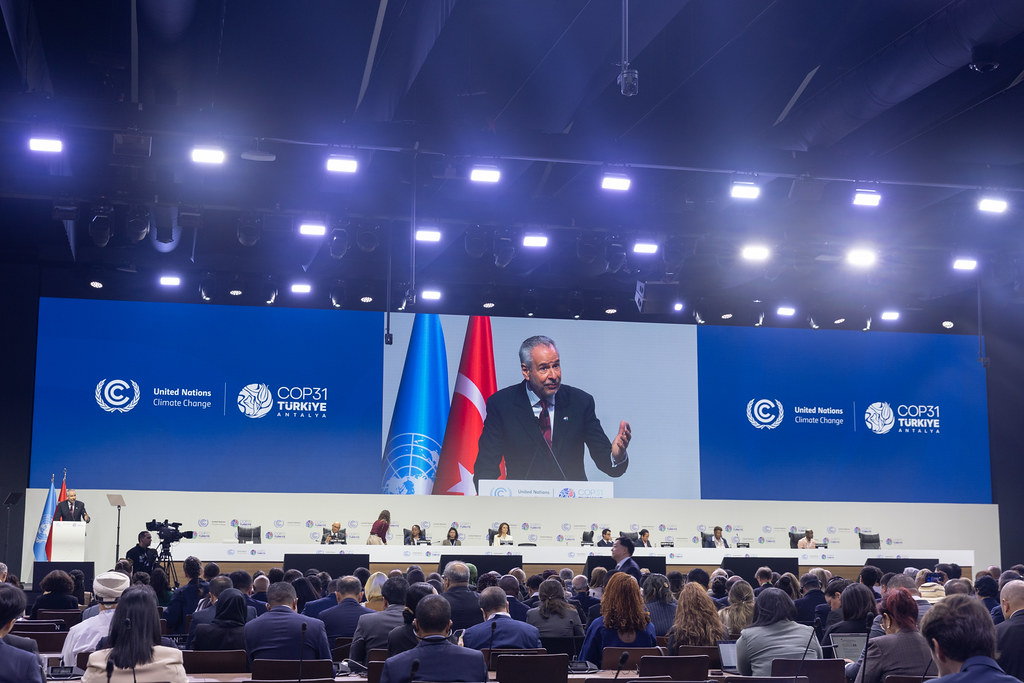
Photo: © UN Climate Change - Kiara Worth
As governments head to Antalya, the COP30 Presidency has delivered its global forest roadmap, the ocean is moving up the climate agenda, and new money is flowing to tropical forests. Nature4Climate is calling on leaders to turn that momentum into decisions, finance, and action on the ground. Here is where we stand and what needs to move in the next two weeks:
Read more
Related articles for further reading
1. Article 6: From Rules to Real Climate Finance
After years of negotiations to establish the rules governing international carbon markets, attention is increasingly shifting toward implementation. At COP31, the key question for Article 6 of the Paris Agreement will be whether countries can begin translating this framework into meaningful climate finance and action at scale.
Under Article 6.2, which enables countries to cooperate through international carbon credit transactions, more bilateral agreements and announcements are expected. However, actual transactions remain limited, with many countries still developing the domestic frameworks needed to authorize credits and avoid double counting. Many countries are also uncertain about their ability to meet their own climate commitments, or nationally determined contributions (NDCs), and are reluctant to authorize international credit transfers that could jeopardize those targets. As 2030 approaches, countries facing potential shortfalls may become more willing to purchase credits, potentially increasing demand. However, unlocking sufficient high-integrity supply remains a challenge, including for the aviation sector under CORSIA.
Meanwhile, Article 6.4, which establishes the UN’s Paris Agreement Crediting Mechanism, faces an important test of its practical effectiveness. Although the Supervisory Body has made some progress developing standards and methodologies, concerns are growing that overlapping requirements could make credible climate activities economically unviable, particularly nature-based solutions.
A circulating open letter calls for greater attention to the combined impacts of these requirements, scientifically robust approaches to reversal risk, and stronger stakeholder engagement.
While major rule changes are not expected at COP31, countries can provide important guidance to shape implementation in 2027. The priority is ensuring that environmental integrity and practical effectiveness advance together, enabling carbon markets to mobilize investment across the full range of credible climate solutions.
2. Tropical Forest Forever Facility: Turning Ambition into Lasting Finance
One year after its launch at COP30 in Brazil, the Tropical Forest Forever Facility (TFFF) is emerging as one of the most ambitious efforts to transform how the world finances tropical forest conservation.
Unlike traditional results-based approaches, the TFFF aims to establish a US$ 125 billion investment facility that generates long-term financial returns to reward countries for keeping forests standing. Eligible countries could receive up to US4 per hectare of standing forest annually, with at least 20% of payments directed to Indigenous Peoples and local communities.
Progress has been made. Eight countries have pledged approximately US$7.8 billion, more than 65 countries have endorsed the initiative, and 34 financial institutions have expressed support. Governance and institutional arrangements are also taking shape, with the facility targeting operations in 2027 and initial payments potentially beginning as early 2028–2029.
However, this isn’t a sure thing and important challenges remain. Funding commitments are still short of the initial US$10 billion target for this year. Questions about forest monitoring, environmental safeguards for investments, and equitable access to payments for Indigenous Peoples and local communities were highlighted before COP31 and at events on the first day.
At COP31, attention will focus on whether governments can build on this momentum, secure additional financial commitments to meet the threshold, and advance the operational arrangements needed to turn the facility’s promise into reality.
3. The Global Deforestation Roadmap: From Commitment to Implementation
On November 5, Brazil’s COP30 Presidency delivered an important milestone with the release of its Roadmap to Halt and Reverse Deforestation and Forest Degradation by 2030, fulfilling a commitment made at COP30. It quickly became one of the most discussed issues on the first day of COP31.
The roadmap provides a framework for accelerating forest action, bringing together existing evidence, experiences and solutions. It identifies priorities across three areas: strengthening national efforts to conserve, sustainably manage and restore forests; improving international cooperation on monitoring, capacity-building, trade and enforcement; and mobilizing and better aligning public and private finance.
Importantly, the roadmap recognizes that protecting forests requires an integrated approach that addresses degradation alongside deforestation, supports sustainable forest management, and recognizes the rights and leadership of Indigenous Peoples and local communities.
However, the roadmap creates no new binding commitments or negotiating process. Its success will depend on governments, businesses and other stakeholders translating its recommendations into concrete policies, investment and action. COP30 President, André Corrêa do Lago, touched on this dynamic when speaking about the roadmap on day one of COP31, “Since this is an implementation document, we need institutions to support countries to develop their own roadmaps. It was very good today to hear UNEP, FAO and UNDP clearly supporting the roadmap. I hope it will make a strong contribution for countries that want to ensure their forests are useful for their people while also being preserved for climate and biodiversity.”
At COP31, the focus will therefore be on building political ownership and momentum for implementation, including through innovative financing approaches such as the Tropical Forest Forever Facility and jurisdictional REDD+.
Nature4Climate coalition partners have welcomed the roadmap as an important achievement while emphasizing a shared message: the world already knows much of what is needed to protect forests. The challenge now is delivering action at the speed and scale required to meet the 2030 goal.
4. EU Policy
The EU has set its course to 2040. The amended European Climate Law commits the bloc to a 90% net cut in emissions by 2040 against 1990 levels. It also allows up to 5% of 1990 net emissions to come from international credits from 2036, after a pilot phase starting in 2031. The Commission’s July ETS proposal would allow up to 260 million international credits between 2036 and 2040.
The detail is still to come. The Commission’s package setting out which credits qualify has slipped to early 2027, and the big open question is how the rules will treat nature. Some in the debate want nature-based credits discounted or treated as temporary, because forests can lose carbon to fire, pests and land-use change.
That risk is real. But it varies by place, and it can be measured and managed through buffers, insurance and longer-term tools such as permanence trusts. Leaving nature out would cut off one of the few sources of mitigation available at scale today, along with the finance it brings to forest countries.
Supply is a concern too. Recent analysis from BeZero and the European University Institute warns that high-quality Article 6 supply may fall short of EU demand, and both call for test projects from 2028. Singapore has already bought nature-based Article 6 credits from Ghana, Paraguay and Peru, which shows what early demand led by quality can look like.
What to watch at COP31: any signal from the Commission on how it will judge durability, new Article 6 deals with partner countries, and whether nature stays in the frame as the 2040 rules take shape.
5. COP17 Recap
At COP17 in Yerevan, Armenia, countries signed off on all major negotiation texts during a nearly 12-hour final plenary, a marked contrast to COP16, which collapsed after losing quorum. The summit marked the halfway point of the Kunming-Montreal Global Biodiversity Framework, the “Paris Agreement for nature,” and delegates selected Quito, Ecuador, to host COP18 in 2028.
Finance, predictably, was at the heart of the discord. With developed countries having missed their pledge to mobilize at least $20bn a year by 2025, the fight centered on whether to broaden the contributor base to include emerging economies. The eventual compromise invites interested countries to “signal interest” through confidential consultations before COP18, while deferring the structure of a new post-2030 financial mechanism.
Reform of nature-harming subsidies moved from the margins to the mainstream, with one observer calling COP17 “a turning point on incentive reform.” Governments spend as much as $1.8tn each year on incentives that can harm biodiversity, particularly across fossil fuels and agriculture, yet 84% of countries missed the 2025 deadline to identify them. The global review “encourages” countries to accelerate action on Target 18, though the language was softened to apply “in accordance with national circumstances” after pushback from Saudi Arabia, Russia and India. Momentum also built outside the negotiating rooms. The presidency launched the “Yerevan call” on positive biodiversity incentives, a political declaration naming subsidy reform one of four flagship priorities for the COP. Alongside it, a new coalition called the “Friends of Target 18” was announced, co-chaired by Colombia and Finland and convened by the International Institute for Sustainable Development.
The landmark Cali Fund, created to share benefits from digital sequence information, remains nearly empty, holding less than $9,000 in actual deposits. Countries reaffirmed indicative contribution rates and agreed an allocation methodology, but pushed most operational details to intersessional talks ahead of COP18.
Released just before the summit, the UN’s global report found the world falling behind on 22 of 23 nature targets, warning that the 2030 goals “will not be achieved” without rapid acceleration.