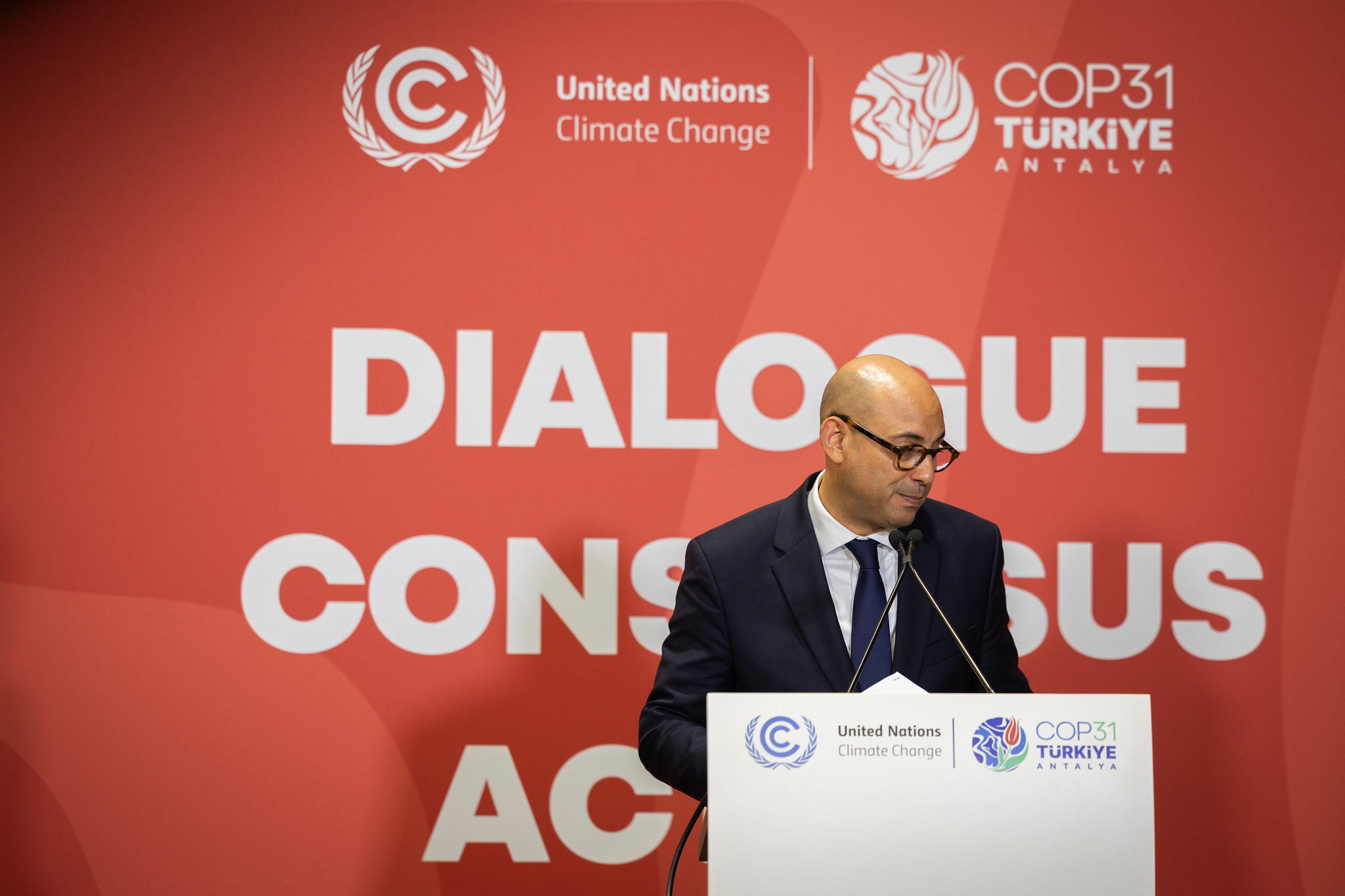
UN Climate Change Executive Secretary Simon Stiell speaks at the final media stakeout (Photo: © UN Climate Change - Kiara Worth)

COP31 ended without its main political agreement after Parties refused to accept a weakened deal that lacked mentions of fossil fuels, backed out of financial commitments and left many developing countries with little room to raise their ambition. Inside the negotiating rooms, ambition fell short on both fronts. Outside them, forests, wetlands, finance and the ocean showed what delivery looks like.
After three drafts and two days of overtime, COP31 became the longest climate summit on record, and ended without a cover decision. When the gavel finally came down in Antalya on 22 November, COP31 President Murat Kurum conceded that there was no agreement on the cover text. It is the first time since Copenhagen in 2009 that a COP has closed without managing to get a deal adopted, and it leaves an even longer list of unfinished business for COP32 to resolve.
That outcome reflects a profound failure of political ambition. Three years after countries agreed in Dubai to transition away from fossil fuels, the final draft did not mention them at all. At the same time, developed countries spent much of the two weeks resisting firm commitments on finance. The US$120 billion floor for tripling adaptation finance was dropped, and without credible support on the table, many developing countries were unable to raise their own mitigation ambition. Neither half of the bargain was delivered.
With the world now set to overshoot 1.5°C, the failure to agree, this late in the game, even to name the main driver of the climate crisis drew sharp reactions. UN Secretary-General António Guterres said he shared the “profound frustration of all those who expected governments to rise to the moment“.
“We went almost 30 years without mentioning fossil fuels, and then it came in, in Dubai, a couple of years ago. To walk back from that would be a mistake.”
John Verdieck, Director of International Climate Policy, The Nature Conservancy
Yet no deal was better than a bad deal. Panama, the EU, the UK, Vanuatu, Norway and the Marshall Islands and others refused to endorse a text that would have walked back commitments already made, and they deserve credit for holding the line.
None of this makes the case against multilateralism. It makes the case for it. The UN climate process is the only place where every country, including the most vulnerable, has a seat at the table. It is the process that gave us the Paris Agreement, the 2030 goal to halt and reverse deforestation and the commitment to move away from fossil fuels. Without it, the world would be much further off track. COP31 exposed the limits of consensus, and it also showed why we need multilateralism to work.
“We applaud the courageous leadership of countless governments and civil society for rejecting a cover decision that does not adequately move us forward on mitigation, adaptation, or finance.”
Cathy Yitong Li, Global Climate & Energy Lead, BirdLife International
What Was on the Table, and What Was Lost
The frustration is sharper because nature had started the second week strongly. The first draft of the cover decision, published on 16 November, called for climate change, biodiversity loss and the degradation of land and ocean to be tackled together. It recognised forests and the ocean as essential, renewed the call to end deforestation by 2030, welcomed the COP30 forest roadmap and backed the IPCC to deliver its next assessment in time for the second Global Stocktake. After talks on Rio Convention synergies were blocked in week one, it was a welcome comeback.
The second draft, released on 19 November, was half the length and much thinner. It kept nature-based solutions as “essential climate solutions” and the 2030 deforestation goal, but dropped the forest roadmap, most of the language on Indigenous Peoples’ rights, the US$120 billion floor for tripling adaptation finance and every reference to fossil fuels. With no cover decision adopted, even the language that survived on nature-based solutions, ecosystem restoration and a multi-year plan for the Ocean and Climate Change Dialogue now lacks a collective political endorsement.
“The progress achieved for the ocean must not be lost. It represents a strong foundation for the work ahead.”
Marine Lecerf, Head of International Policy, Ocean & Climate Platform
Not everything fell with the cover text. Countries adopted decisions on adaptation, the Adaptation Fund and just transition, and agreed to set up a task force to refine the Belém adaptation indicators by October 2027. The Article 6.2 rules on carbon market cooperation between countries were closed, and the second Global Stocktake was formally launched. But the adaptation finance gap remains wide open: this year’s Adaptation Fund pledges totalled around US51 million, against a goal of at least US300 million a year.
Where the Ambition Came From
As in week one, most of COP31’s real ambition came from outside the negotiating rooms. The first week set the tone. The Leaders’ Summit Event on Forests brought new money for the Tropical Forest Forever Facility (TFFF), Ghana became the first African country to receive jurisdictional REDD+ credits under ART’s TREES standard, Indonesia moved nine provinces towards the same standard, and the Peatland Breakthrough launched with a US$100 billion global target. Read our full week one recap for the details.
Week two kept the momentum going:
- Forest finance: Canada pledged up to C$560 million to the TFFF, and a coalition of philanthropies added 85 million to the pot, bringing the facility to around US8.3 billion of its 10 billion target. WWF and UNDP launched an Eligibility Support Programme to help forest countries and territorial leaders get ready to receive payments.
- Jurisdictional REDD+: Madagascar launched Ala Velona, a programme covering around 55% of its forests, and Papua New Guinea signed a memorandum of understanding with Emergent, coordinator of the LEAF Coalition, to explore future forest credit transactions.
- Fire: more than 20 countries backed the Antalya Action Plan on Integrated Fire Management, led by Türkiye with Brazil and the Republic of Korea. Fire accounted for 42% of global tree cover loss in 2025.
- Land rights: one year on from the Intergovernmental Land Tenure Commitment, Brazil reported progress on regularising 6 million hectares of Indigenous and quilombola territories, and Indonesia has designated more than 376,000 hectares of customary forest.
- Ocean: the Presidency published the Antalya Ocean and Seas Compact, the Blue NDC Challenge launched an Implementation Taskforce and welcomed ten new members, the Mangrove Breakthrough reported nearly US$ 1 billion in mangrove-positive investments since 2020, and the Global Fund for Coral Reefs announced around US$ 20 million in new commitments.
- Joined-up action: the Rio Synergies Group for Action launched as a voluntary, country-led platform; ENACT and N4C launched the Power of Nature Plan to Accelerate Solutions, and 25 countries backed the Wildlife for Climate Declaration.
“Progress in addressing climate change and protecting nature does not need to wait for decisions. We can all move forward faster – and we must do so.”
Christine Dragisic, Managing Director for Global Policy, National Audubon Society
The carbon market rules still matter, though. Decisions on Article 6.4 will shape what role forests, peatlands, and other ecosystems can play, and forest countries made their case firmly. Writing in Carbon Pulse, Dr Joseph Appiah-Gyapong of Ghana’s Forestry Commission warned that stacking conservative rules without weighing their cumulative effect could shut credible programmes out of the market.
“The surest way for a crediting mechanism never to issue a bad credit is never to issue any… Ultimately, the success of Article 6.4 should not be measured by how many activities its rules exclude, or how conservative its assumptions appear on paper. It should be measured by how much credible climate action it enables.”
Dr Joseph Appiah-Gyapong, Acting Director, Climate Change Unit, Forestry Commission Ghana
How Did Nature’s Asks Fare?
Before COP31, the Nature4Climate coalition set out its asks for Antalya, inside and outside the negotiating rooms. Here is where they landed.
Green: delivered or strong progress · Amber: partial progress · Red: stalled or lost
If the scorecard below shows more amber and red than green, that tells an important part of the COP31 story. It is an assessment of political outcomes: many of the coalition’s asks did not make it across the line in Antalya, and some moved backwards. But the signals from the two weeks were more nuanced, and often more encouraging, than the final text suggests, from new money for forests and jurisdictional REDD+ moving into delivery to coalitions of countries advancing action on wetlands, fire and the ocean. These asks were never a two-week checklist. Progress on forest finance, carbon markets, wetlands, ocean action and the 2030 forest goal happens between COPs as well as inside them. The scorecard is best read as a progress check rather than a final score, and these issues will be tracked closely over the year ahead.
| Ask | Status | Where it landed |
Rio Conventions: adopt a decision advancing cooperation across the climate, biodiversity and land conventions |
Red | Talks ended with procedural conclusions and were deferred to June 2027. Synergies language returned in the first cover draft but fell with the cover decision. Outside the talks, the Rio Synergies Group for Action launched. |
Adaptation: operationalise the Belém indicators and close data gaps, including for nature-based approaches |
Amber | A task force will refine the indicators by October 2027, with the major milestones expected at COP32. The figure for tripling adaptation finance was dropped. |
| Ocean: champion the Blue NDC Challenge, agree a multi-year plan for the Ocean Dialogue and scale coastal finance | Amber | The Blue NDC Challenge launched an Implementation Taskforce and gained ten members, and the Antalya Ocean and Seas Compact was published. Nearly US1 billion has gone into mangroves since 2020, and coral reefs gained around US20 million. The multi-year Dialogue plan was in the draft text but was not adopted. |
NDCs and the Global Stocktake: reflect nature’s role, and the finance it needs, in the second Global Stocktake |
Amber | The second Global Stocktake formally launched and runs to 2028. Cover text recognising nature-based solutions as essential was not adopted. It is too early to judge. |
Finance: turn the Baku–Belém Roadmap into bankable pathways that include nature |
Red | There was little progress. Climate finance remained one of the main sticking points, and no cover decision was adopted. |
Nature markets: catalyse the TFFF, jurisdictional REDD+ and high-integrity carbon markets, with direct funding for Indigenous Peoples and local communities |
Green | The TFFF reached around US$8.3 billion, with 20% of its payments earmarked for Indigenous Peoples and local communities. Ghana became the first African country to receive TREES credits, and Indonesia, Madagascar and Papua New Guinea advanced their own programmes. |
Article 6: give the Supervisory Body guidance that balances integrity with practicality and scalability |
Amber | Article 6.2 closed. The Article 6.4 draft asked the Supervisory Body to weigh practicality and the cumulative effect of conservative rules. |
Wetlands: accelerate action on wetlands; integrate peatlands and mangroves into NDCs and national adaptation plans |
Amber | The Peatland Breakthrough launched with a US$100 billion global target. Ireland announced as Champion country. Uganda, Jamaica and Indonesia put peatlands or mangroves into their plans, and CAF raised its green lending target. Ethiopia joined Freshwater Challenge. Wetlands and freshwater were still missing from the cover text. |
Forests: show collective ownership of the forest roadmap and feed its progress into the second Global Stocktake |
Amber | The roadmap was welcomed in the first draft but dropped from the second, so no Global Stocktake link was secured. Brazil adopted a national roadmap, and more than 100 organisations signed a joint call to keep it moving. |
The Road to Addis Ababa
Attention now turns to COP32 in Addis Ababa. Ethiopia is expected to make it a COP focused on adaptation and food systems, two tracks where nature is vital, and where water security and healthy freshwater ecosystems are fundamental to resilience, and it will also have to resolve most of the deadlocks left over from Türkiye, from adaptation finance to the transition away from fossil fuels. The second Global Stocktake, which runs to 2028, will decide how far forests, wetlands and other freshwater ecosystems, land and the ocean count in the world’s assessment of progress. With 2030 just four years away, the forest goal needs a political moment in 2027, from Davos to the G20 and ASEAN. The TFFF still needs almost US2billiontoreachitsyear-endtargetandunlockNorway’sUS3 billion pledge. And the year ahead will test whether adaptation finance, including for ecosystem-based adaptation, and direct finance for Indigenous Peoples and local communities finally start to flow.
“COP32 would be an ideal moment to really highlight the valuable contribution that healthy ecosystems of different types can make to addressing the climate challenge, while at the same time re-emphasising the need to reduce emissions across all sectors.”
Sandeep Sengupta, Head of Global Climate Policy, IUCN
The work now moves to the months between COPs. Before Addis Ababa, the test will be whether renewed political mobilisation on implementation towards the 2030 forest goal, including through the recommendations in the forest roadmap, is put into practice; whether the TFFF reaches its capitalisation target and makes further advancements; whether carbon market rules make room for high-integrity nature, and whether nature counts fully in the second Global Stocktake. The coalitions that delivered in Antalya will need to carry that ambition back into the multilateral process, so that what is happening on the ground is matched by what governments are willing to sign.